
No products in the cart.
Sermorelin in research: an introductory overview

Written by
Hannah Whitaker
Research Content Editor
 15 Oct 2026
 8 min read
Sermorelin is a synthetic peptide related to growth hormone-releasing hormone (GHRH), a signal involved in the body’s regulation of growth hormone release. In research, the name describes a compound and its biological context; it does not, by itself, establish a health benefit or make a research material suitable for human use.
- Sermorelin is studied in relation to GHRH and pituitary signalling.
- A proposed biological mechanism is not proof of an outcome such as changes in body composition or performance.
- Product identity, batch-specific documentation and stated laboratory-use conditions are key checks when reviewing research materials.
What sermorelin is and how it is classified
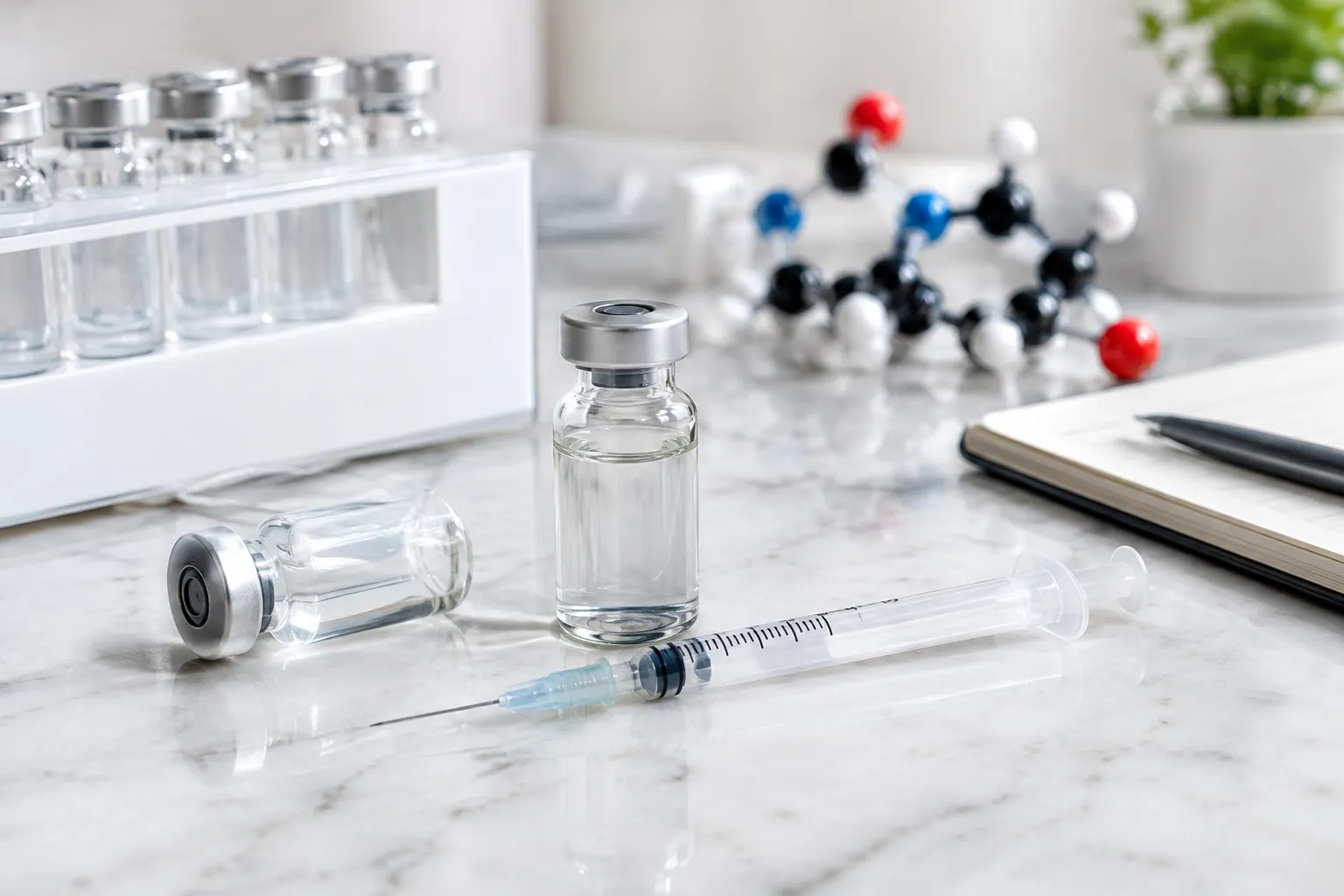
Sermorelin is a peptide associated with GHRH research. GHRH is a naturally occurring hormone signal involved in prompting the pituitary gland to release growth hormone. Sermorelin is described as a GHRH analogue or fragment in research and product contexts; those terms refer to its relationship to the signalling molecule, not to a demonstrated outcome.
The classification is useful when reading scientific material: sermorelin belongs to a different category from growth hormone itself. It is not the same compound, even though both may be discussed in connection with growth hormone biology.
Names and descriptions can vary between research documents and listings. When reviewing a specific material, check the stated identity and form rather than relying on a familiar name alone. Arma Peptides lists Sermorelin 10MG; the listing should be read alongside its available product and batch documentation.
The biological context behind sermorelin research

Growth hormone-releasing hormone and pituitary signalling
In broad terms, GHRH is a signal that acts on the pituitary gland, which can then release growth hormone. Sermorelin research focuses on this relationship with the signalling pathway. The pathway provides biological context for why researchers may study the peptide; it does not tell us what a particular product will do in a person.
Growth hormone signalling is part of a wider biological system, and describing one link in that system is not the same as showing a clinically meaningful effect. Research findings must be interpreted in the context of the specific material, methods, study population and outcome being examined.
Ipamorelin is another peptide encountered in discussions of growth hormone-related research, but it is not interchangeable with sermorelin. Readers comparing terminology can review the Ipamorelin 10mg listing as a separate product reference, while keeping each compound’s identity and documentation distinct.
Why pathway descriptions are not outcome evidence
A mechanism explains how a compound might interact with a biological process. It does not establish that the compound produces a particular effect, that the effect is useful or safe, or that findings in one research setting apply to another.
For example, a description connecting sermorelin with pituitary signalling does not prove claims about muscle growth, weight change, recovery or general wellbeing. Those claims require evidence designed to test the relevant outcomes, not just an explanation of a pathway.
When reading a product description or research summary, separate three questions:
- What biological relationship is being proposed or studied?
- What evidence directly measures the outcome being claimed?
- Does that evidence concern the same compound, formulation and context?
If those questions are not clearly answered, treat outcome language cautiously.
Terms readers may encounter in peptide research
Peptide materials are often described using technical terms that can sound more conclusive than they are. Understanding the distinctions helps readers assess what a label, product page or laboratory report actually establishes.
For context, KPV 10mg UK is another peptide listing. Its presence alongside sermorelin-related material does not make the compounds equivalent; each should be evaluated on its own identity and documentation.
Sermorelin and sermorelin acetate
“Sermorelin” names the peptide discussed in this article. “Sermorelin acetate” refers to a form in which the peptide is associated with acetate. A product or document may use one name or the other, so compare the exact identity stated on the listing, label and batch paperwork.
A name alone does not confirm the contents of a particular vial or establish its purity. Product identity should be supported by clear documentation that corresponds to the relevant material and batch.
Research-grade, purity and assay terminology
“Research-grade” describes a stated intended context or product category; it is not, on its own, a universal certification or proof that a material meets a particular standard. Check how the supplier defines the term and what supporting information is available.
“Purity” is an analytical result reported under a specified method. It should be read with the method, sample identity, batch information and report details in view. A purity figure does not necessarily establish identity, concentration in the supplied material, sterility, suitability for a particular experiment or safety for human use.
An “assay” is an analytical procedure used to examine a sample or measure a specified property. The method and the result matter: a report should make clear what was tested and what the reported result represents. Avoid treating a single number as a complete assessment of quality.
Evidence limits and research-only status

Sermorelin’s connection to GHRH provides a biological research context, but it does not settle questions about clinical effects, risks or appropriate use. Evidence must be assessed by looking at the specific question studied and the quality and relevance of the evidence—not by inferring a benefit from a plausible mechanism or from product marketing language.
Research materials are not presented as medicines or for human use. A research-grade label and an analytical report do not convert a product into an authorised medicine, establish a treatment indication or provide instructions for personal use. In the UK, readers should check current regulatory information for the status of any medicine or substance rather than assuming that availability online means it is authorised for human use.
For personal medical questions, including questions about a prescribed medicine or symptoms, consult a qualified doctor or pharmacist who can consider your circumstances.
Checks to make when reviewing sermorelin materials
Before evaluating a research material, make sure the product description and supporting documents are specific enough to assess. A practical review starts with identity, then batch evidence, then handling and supplier information.
Review batch-specific COAs and HPLC results
A certificate of analysis (COA) is most useful when it identifies the material and the batch it covers. Check that the batch or lot number matches the product documentation, and look for the date, laboratory or testing provider, methods used and results reported.
High-performance liquid chromatography (HPLC) can be used to analyse a sample and report a chromatographic profile or purity-related result. A mention of HPLC alone does not show what was tested or what the result means. Review the actual report for the method, sample identification and findings; where a result is unclear, seek clarification rather than treating a headline claim as a substitute for the report.
A COA may document results for the sample tested, but it does not automatically establish every quality attribute of the supplied material. Confirm which properties were examined and whether the report addresses the questions relevant to the intended laboratory work.
Check product identity, handling and supplier details
Compare the product name and form across the product page, label and COA. Confirm that the batch reference is consistent, and check whether the stated specification and handling guidance are clear. If storage conditions or other handling information are relevant to your laboratory procedures, consult the supplier’s instructions and the relevant research protocol.
It is also useful to note what the available documents do not establish. For example, a purity result should not be read as proof of sterility or human-use suitability unless those properties are specifically addressed and supported. Clear documentation helps readers distinguish reported facts from assumptions.
Sermorelin FAQ
Where is the best place to inject sermorelin?
There is no injection-site guidance for research-only sermorelin materials in this article; they are not presented for human use. For any prescribed medicine, follow its approved instructions and the advice of the prescriber or pharmacist.
What negative effects have been reported or investigated for sermorelin?
Reported or investigated effects depend on the specific formulation and context studied, so a research product description cannot establish a reliable safety profile for personal use. Review relevant clinical and regulatory information with a qualified health professional.
Can sermorelin affect thyroid function?
The relationship between sermorelin and thyroid function cannot be established from its GHRH-related mechanism alone. Anyone concerned about thyroid health or taking related medication should discuss their situation with a doctor or pharmacist.
Is sermorelin associated with weight loss?
A proposed relationship to growth hormone signalling does not establish sermorelin as a weight-loss treatment or show that it changes body weight. Treat weight-loss claims as claims requiring direct, relevant evidence.
How does sermorelin compare with testosterone replacement therapy?
Sermorelin and testosterone replacement therapy refer to different substances and biological pathways, so they are not interchangeable options. Their use and suitability are medical questions that require assessment by a qualified clinician.
Does sermorelin increase body size or muscle growth?
A biological pathway description does not prove that sermorelin increases body size or muscle growth. Such outcomes require direct evidence in an appropriate research context and should not be inferred from product descriptions.
Is sermorelin approved for human use in the UK?
A product being available online does not establish that it is authorised as a medicine for human use in the UK. Check current information from the relevant UK regulator and do not treat research materials as medicines.
What should a batch-specific certificate of analysis include?
A useful batch-specific COA identifies the product and matching lot, gives the testing date and method, and reports results clearly. Check which properties were tested and whether the report covers the material under review.
Use documentation to guide your next research step
A careful review of sermorelin starts with the compound’s identity and biological context, then turns to the limits of the evidence and the details of the specific material. Keep pathway explanations separate from claims about outcomes, and do not treat a research-use designation or a single test result as a substitute for broader documentation.
For laboratory evaluation, compare the product information with its batch-specific COA, note the analytical methods and results, and confirm that handling details are clear. Use scientific and regulatory information appropriate to the question, and keep research materials within their stated laboratory-use context.
About the author
Hannah Whitaker
Research Content Editor
Hannah Whitaker is a UK-based science writer with a background in life-sciences communications, specialising in research-use peptides and laboratory product information. She makes HPLC verification, batch certificates of analysis and product documentation clear and accessible for readers seeking well-documented research materials. Her articles draw on published research and supplier documentation, with a measured approach to product handling and evidence. She clearly distinguishes laboratory research use from clinical or personal use.
Research-use peptide resourcesHPLC verification and batch COAsLaboratory product documentationResearch-use handling information
Powered by SeoVision — authority building for online stores


Related posts

Kisspeptin is a family of signalling peptides studied for its role in communication between the brain and the reproductive hormone system. Continue reading

Reviews of peptide suppliers in the UK can help you assess communication and delivery, but customer ratings alone cannot verify what is in a product. Continue reading

Glow 70mg is a product name that raises two separate questions: what the label describes and what evidence supports the product. Continue reading
MGF and PEG-MGF names can look similar in search results, but a shared name does not establish that two listings describe the same material. Continue reading

For anyone searching for retatrutide in the UK, the key question is not simply where to buy it, but whether a research listing gives enough... Continue reading
Add comment