No products in the cart.

Research use only
This product is supplied strictly as a laboratory research chemical and is sold for in-vitro and laboratory research purposes only. It is not for human consumption and not for veterinary consumption. It is not a medicine, holds no UK or EU marketing authorisation, and is not intended to diagnose, treat, cure or prevent any condition. It must not be administered to humans or animals, and must be handled only by qualified personnel under appropriate laboratory conditions. Not for resale.
What Is Kisspeptin?
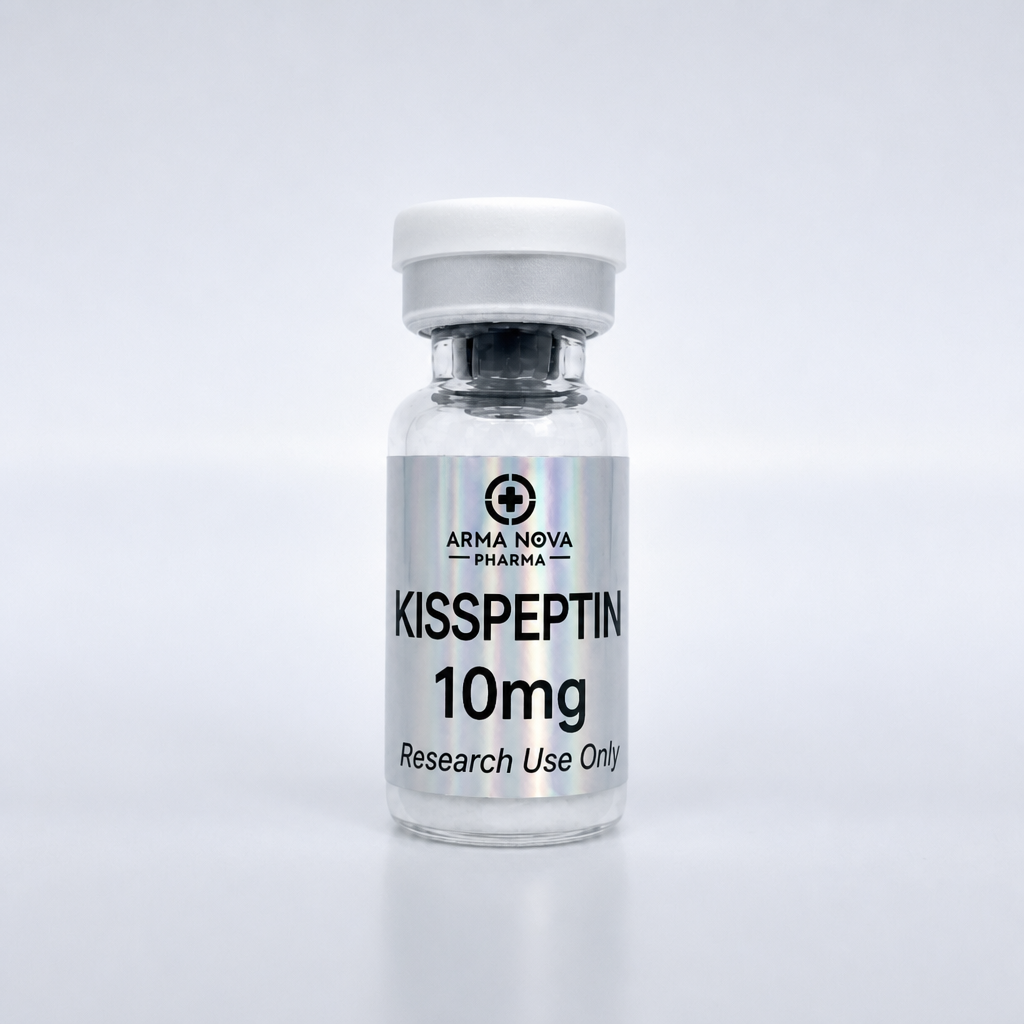
Kisspeptin 10mg refers to the synthetic form of Kisspeptin-10 (KP-10), a decapeptide derived from the C-terminal region of the KISS1 gene product. It is the shortest biologically active fragment of the kisspeptin family, retaining full agonist activity at the KiSS-1 receptor (GPR54/KISS1R). Kisspeptin 10mg is widely used in neuroendocrine research as a tool compound to study the upstream regulation of the hypothalamic-pituitary-gonadal (HPG) axis. Its molecular formula is C₆₃H₈₃N₁₇O₁₄ with a molecular weight of 1,302.4 g/mol. Full compound data is available on the PubChem entry for Kisspeptin-10 (CID 25240297). The compound is also catalogued on ChEMBL as CHEMBL376756.
Kisspeptin 10MG: Key Research Facts
Mechanism of Action
Kisspeptin 10mg acts as a potent agonist at GPR54, a Gq-coupled receptor expressed on hypothalamic GnRH neurons. Receptor activation triggers intracellular IP3 and DAG signalling, leading to depolarisation of GnRH neurons and downstream pulsatile release of gonadotrophin-releasing hormone (GnRH). This in turn stimulates pituitary release of LH and FSH, making Kisspeptin 10mg a key upstream regulator of the entire reproductive hormonal cascade. The direct stimulation of GnRH secretion by kisspeptin is well established in published literature, including Gottsch et al. (PMC545088), a foundational study on kisspeptin-GnRH neuron signalling.
Research Areas
Kisspeptin 10mg is used across a range of neuroendocrine and reproductive biology research programmes:
- HPG axis regulation — GPR54 receptor activation kinetics, GnRH pulsatility modelling, and LH/FSH secretion assays
- Reproductive neuroendocrinology — puberty onset signalling, folliculogenesis, ovulation timing, and gonadotrophin surge research
- Metabolic-reproductive crosstalk — kisspeptin interactions with energy balance sensors and feedback to the hypothalamus
- Cancer biology — KISS1 as a metastasis suppressor gene, trophoblast invasion inhibition, and tumour microenvironment studies
A comprehensive review of kisspeptin’s role in the reproductive axis is available via PMC4508256 on NCBI.
Supplied Format & Specification
| Parameter | Specification |
|---|---|
| Peptide | Kisspeptin-10 (KP-10) |
| Amount | 10mg per vial |
| Form | Lyophilised powder |
| Appearance | White to off-white powder |
| Purity | ≥99% (HPLC verified) |
| Molecular Formula | C₆₃H₈₃N₁₇O₁₄ |
| Molecular Weight | 1,302.4 g/mol |
| CAS Number | 374675-21-5 |
| Storage | −20°C, away from moisture and light |
| Usage | Research use only |
Purity & Quality Assurance
Every batch of Kisspeptin 10mg supplied by Arma Peptides undergoes independent third-party testing. Purity is confirmed at ≥99% by HPLC and identity verified by mass spectrometry. Batch-specific CoA documentation is published on our laboratory tests page.
Storage Conditions
Store lyophilised Kisspeptin 10mg at −20°C in a dry, dark environment. Avoid repeated freeze-thaw cycles. Once reconstituted for in vitro use, aliquot and store at −80°C to preserve activity.
Related Research Peptides
Researchers studying the HPG axis and reproductive neuroendocrinology often combine Kisspeptin 10mg with complementary secretagogues. Browse related peptides from Arma Peptides:
- Ipamorelin 5mg — selective GH secretagogue for pituitary axis studies
- GHRP-6 5mg — ghrelin receptor agonist used in GH and appetite signalling research
- CJC-1295 No DAC 10mg — GHRH analogue for pulsatile GH release protocols
- DSIP 5mg — delta sleep-inducing peptide studied in neuroendocrine and sleep-cycle research
- Selank 10mg — anxiolytic neuropeptide analogue for CNS and stress-axis research
- Epithalon 10mg — tetrapeptide studied in pineal gland and endocrine regulation models
Reviews
There are no reviews yet.