No products in the cart.

Research use only
This product is supplied strictly as a laboratory research chemical and is sold for in-vitro and laboratory research purposes only. It is not for human consumption and not for veterinary consumption. It is not a medicine, holds no UK or EU marketing authorisation, and is not intended to diagnose, treat, cure or prevent any condition. It must not be administered to humans or animals, and must be handled only by qualified personnel under appropriate laboratory conditions. Not for resale.
What Is BPC-157 TB500 Blend 20mg?
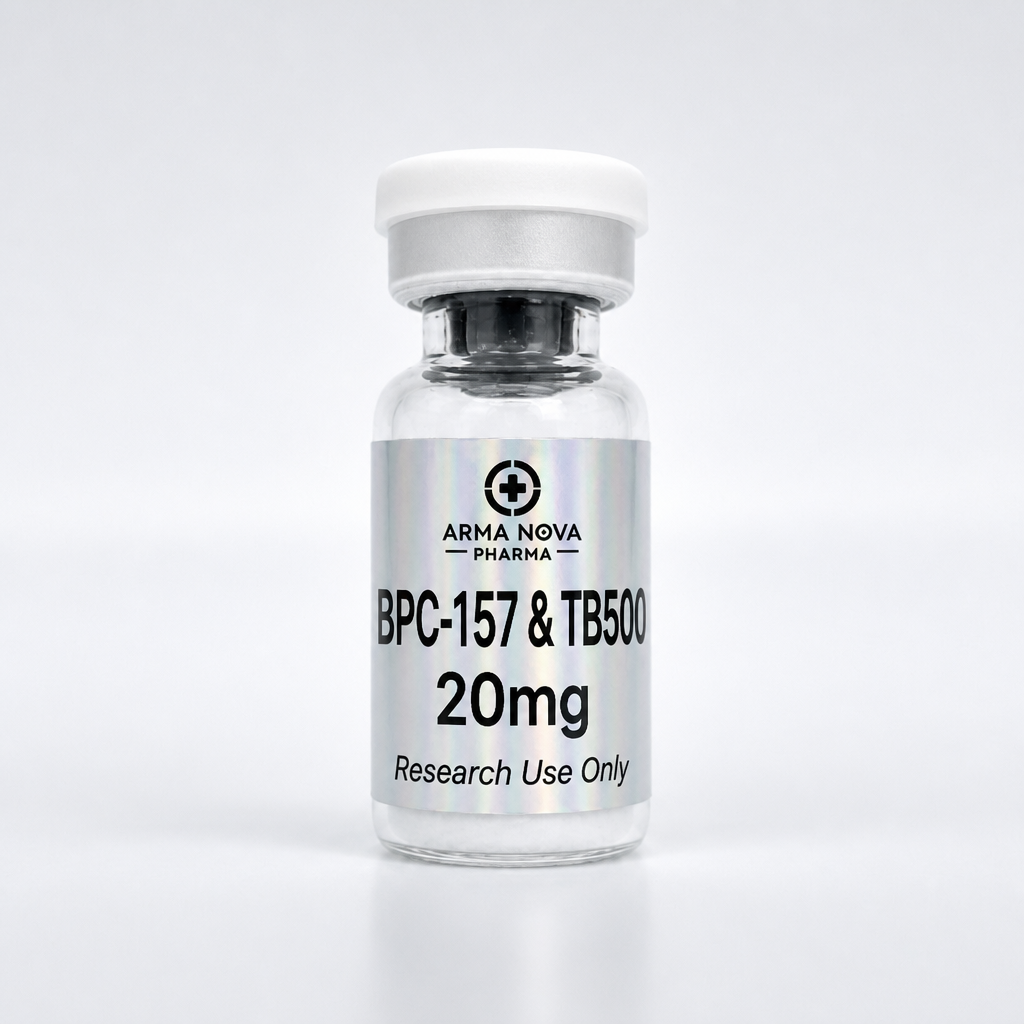
BPC-157 TB500 Blend 20mg is a lyophilised dual-peptide research compound supplied as a white powder in a sealed vial, containing 10mg of BPC-157 and 10mg of TB-500 at a 1:1 ratio. This high-yield 20mg format is intended for preclinical studies requiring extended investigation of combined peptide activity across multiple biological pathways. BPC-157 (Body Protection Compound 157) is a synthetic 15-amino-acid gastric pentadecapeptide with molecular formula C₂H₉₈N₁₆O₂₂, molecular weight 1,419.535 g/mol, and CAS number 137525-51-0 (PubChem CID 9941957). TB-500 is a synthetic fragment of Thymosin Beta-4, a 43-amino acid protein with molecular formula C₂₁₂H₃₅₀N₅₆O₇₈S, molecular weight 4,963.44 g/mol, and CAS number 885340-08-9 (PubChem CID 62707662). All batches of BPC-157 TB500 Blend 20mg are independently verified at ≥99% purity by HPLC and mass spectrometry — results available on our Certificate of Analysis page. For research use only.
BPC-157 & TB500 BLEND 20MG: Key Research Facts
Dual-Pathway Research in a Single Vial
The BPC-157 TB500 Blend 20mg provides researchers with two mechanistically distinct peptides in a single, high-concentration formulation. BPC-157 exerts its primary effects through growth hormone receptor (GHR) upregulation in tendon fibroblasts, VEGFR2-mediated angiogenesis, nitric oxide pathway modulation, and collagen synthesis stimulation. TB-500 acts via a fundamentally different mechanism: it sequesters G-actin through its conserved LKKTET motif, regulating cytoskeletal dynamics to drive cell migration, proliferation, and differentiation at injury sites. By combining both compounds at equal doses, the BPC-157 TB500 Blend 20mg allows researchers to simultaneously investigate complementary repair signalling without running parallel experiments on separate cohorts — reducing both experimental complexity and material cost per study.
BPC-157 Component — Research Profile
BPC-157 has been extensively studied in in vivo models of tendon, ligament, muscle, bone, and gastrointestinal tissue injury. It is notable for its high chemical stability — unlike many peptides, BPC-157 retains activity across a wide pH range and in the presence of gastric acid. Published preclinical data indicates upregulation of early growth response protein 1 (EGR1) in fibroblast cultures, accelerated collagen type I deposition, and promotion of blood vessel formation in wound bed models. A comprehensive review of BPC-157’s healing mechanisms is available on PubMed Central (PMC8228050).
TB-500 Component — Research Profile
TB-500 is the 17-23 amino acid fragment of Thymosin Beta-4 (Tβ4), a ubiquitous actin-sequestering protein expressed in virtually all mammalian cells at high concentrations. As the biologically active domain of the full-length protein, TB-500 retains the capacity to upregulate cell-surface actin, promote angiogenesis, reduce acute and chronic inflammation, and support cardiac and skeletal muscle repair in preclinical models. Research published in Applied Sciences (2026) provides a current scoping review of TB-500 and Thymosin Beta-4 across tissue healing, regeneration, and musculoskeletal repair models, confirming its continued relevance as a research peptide.
Why Choose the 20mg Format?
The BPC-157 TB500 Blend 20mg is suited to research protocols requiring larger sample sets, longer-duration study windows, or dose-escalation designs. At 10mg per peptide component, the BPC-157 TB500 Blend 20mg allows researchers to prepare a greater number of reconstituted aliquots from a single vial compared to the 10mg format, improving batch-to-batch consistency and reducing reconstitution frequency. The lyophilised powder format ensures stability during storage and extends usable shelf life when kept at −20°C. Researchers running comparative studies between isolated peptides and the BPC-157 TB500 Blend 20mg will find the higher vial content particularly advantageous for multi-arm experimental designs.
Storage & Handling
Store BPC-157 TB500 Blend 20mg lyophilised powder at −20°C, protected from light and moisture. Reconstitute using bacteriostatic water or sterile saline immediately prior to use. Once reconstituted, store at 4°C and use within 28 days. Do not refreeze reconstituted solution. Handle under sterile laboratory conditions. This compound is not approved for human use.
Technical Specifications
| Parameter | BPC-157 | TB-500 |
|---|---|---|
| CAS Number | 137525-51-0 | 885340-08-9 |
| Molecular Weight | 1,419.535 g/mol | 4,963.44 g/mol |
| PubChem CID | 9941957 | 62707662 |
| Sequence Length | 15 amino acids | 17 amino acids (fragment) |
| Purity | ≥99% (HPLC verified) | |
| Vial Content | 10mg | 10mg |
| Total Blend | 20mg lyophilised powder | |
| Storage | −20°C, away from light and moisture | |
| Reconstitution | Bacteriostatic water or sterile saline | |
Related Research Peptides
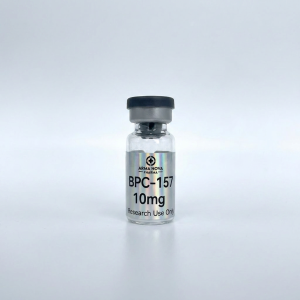
- BPC-157 10mg — isolated BPC-157 for single-peptide research protocols
- TB-500 5mg — isolated TB-500 for Thymosin Beta-4 pathway studies
- GHK-Cu 50mg — copper peptide studied for tissue remodelling and collagen synthesis
- Ipamorelin 5mg — GH secretagogue used in recovery and cellular repair research
- Selank 10mg — tuftsin-analogue neuropeptide studied alongside regenerative compounds
Reviews
There are no reviews yet.